
Trace Benzie County Former Owners
The Benzie County Register of Deeds keeps the county's land-record index. Pull the newest deed for the exact tract and move backward one transfer at a time. Deed evidence extends the chain; historical context only decorates it.
| Source | Years It Covers | Where Held | What It Shows |
|---|---|---|---|
| Grantor/grantee index and images | Mid-1800s onward | Register of Deeds, Tapestry | Recorded parties, dates, and references |
| Historic assessment rolls | Selected series from 1862 | Archives of Michigan | Taxable property and dated name leads |
| Atlases and plat books | Selected editions from 1901 | Library collections | Lot, place, and resident-landowner context |
| Newspapers and burial permits | Selected runs from 1888 | Benzonia Library | Name, date, address, and estate clues |
Each deed row should carry a transfer date, grantor, grantee, deed type, document or liber/page number, and the matching legal description. Names repeat. Trusts, estates, and business entities can appear in forms that look nothing like a personal name. A tax roll or atlas may suggest where to look. Only a recorded transfer proves the prior owner.
Benzie's Mid-1800s Deed Depth
Benzie's deed record runs deep. The recorder states that the grantor/grantee index and its images reach back to the mid-1800s, though no exact first year is given. Tapestry serves as the fee-based public route, while Laredo is built for professional use. When an online chain of former owners stops, keep the last sound citation and ask the recorder about the applicable book, index, or image. The county reports no courthouse fire and no destroyed deed decade. Missing results deserve no invented explanation.
Benzie was set off from Leelanau in 1863 and organized in 1869. Early officers met at John Bailey's home in Benzonia. Township assessment books and early maps from that era can supply context around the first county-era transfers and the prior owners behind them. They remain leads, not deeds.
Coverage limit. “Mid-1800s” is the verified online depth for former-owner research. The county does not state one precise first index year.
Decode Benzie Document Numbers
Equalization's reference conventions translate book-era citations into Tapestry terms. A modern certificate or trust record looks like 2023-00001, while 2004R-00001 marks a deed and 2004S-00001 a survey. Converted liber forms exist too. An old bound-book citation such as 217/698 still appears in many files. None of these strings is a parcel number.
The Benzie County Register of Deeds page identifies the online index and the copy routes behind a document-number search.
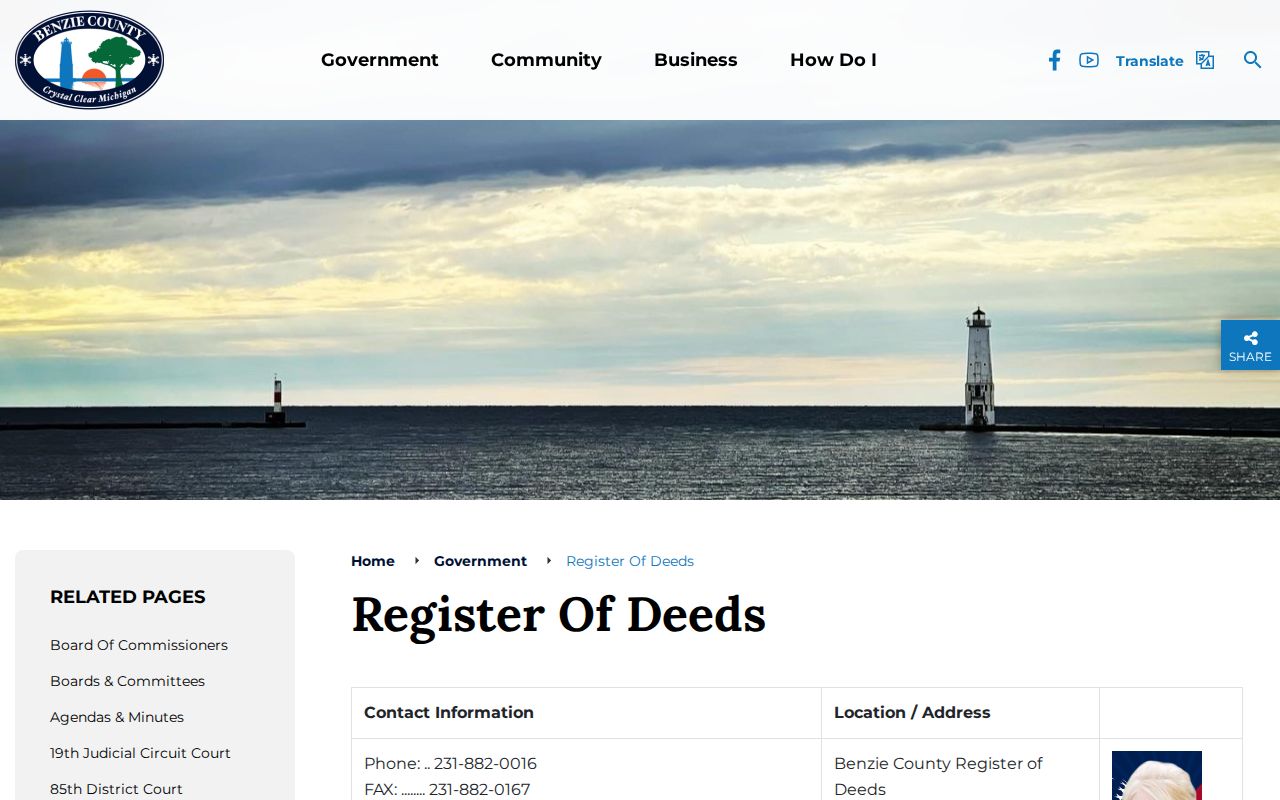
The county page sets the depth. Grantor and grantee indexes and images extend to the mid-1800s. Exact citations still need matching to the instrument. Keep the old citation and the converted identifier both. One may be printed on the deed while the other retrieves the indexed image, letting former-owner work cross from paper references to the modern portal without losing its source trail.
Reconstruct Benzie Ownership Backward
Rebuilding who held a Benzie County parcel works best in reverse, one owner of record at a time, with each deed checked against the last. Slow down whenever the legal description shifts, probate enters the picture, or a split assigns the land a new parcel number.
- Copy the current parcel number, municipality, owner spelling, and legal description from the assessment roll.
- Find the newest deed naming that owner as grantee. Save the grantor, date, deed type, and record reference.
- Search that grantor as an earlier grantee, then confirm that the land description still matches.
- Repeat until the target date or the index limit, branching when a split, estate, or renamed entity changes the trail.
- Grantor
- The party transferring the recorded interest.
- Grantee
- The party receiving the recorded interest.
- Chain of title
- The linked series of instruments affecting the land.
- Legal description
- The recorded words that identify land more reliably than an old street address.
Resolve Benzie Probate Transfers
A death can break a neat sequence of private deeds. Probate Court often explains the gap. A docket may name the estate, representative, or order behind an administrator deed. Combine a death date, docket, recorded order, and later deed only when the parcel and the names agree. An heir named in a file is not automatically a former owner.
The MiCOURT probate search supplies a case lead. Request the public case file when the index shows no order. The Register of Deeds records probate orders and administrator transfers. That returns the chain to the land index.
Track Changed Benzie Parcels
A parcel split or combination can replace an APN. Part of the old tract can remain inside the new one. Compare metes-and-bounds text, lot and block, prior references, surveys, and plats. Colligo may orient the site. The deed and plat control the documentary link.
Frankfort sets two exact search traps. Equalization distinguishes "Frankfort, Second Add" in Frankfort from "Frankfort, 2nd Add" in Elberta. The Crystal Lake Township road directory also links Beech Street with Oliver Road. It also links Bellows Avenue with Seventh Street. Search each form, then verify the municipality and legal description.
Mine Historic Benzie Owner Clues
The Archives of Michigan guide lists Benzonia Township taxable-property statements and assessment rolls beginning in 1862. Blaine Township rolls run through 1949. The Library of Michigan guide identifies the Benzie Banner from 1888 and Frankfort Fruit and Farm News from 1897. One atlas dates to 1901. The 1901 volume carries a mailing list of resident landowners, useful for flagging a name variant or a broad location, and a second atlas followed in 1915.
Benzonia Public Library offers more. Its shelves hold local newspapers, plat books, cemetery sources, and an archive project that transcribed about 600 burial permits from 1912 through 1940. A burial permit can tie a death or an old address to a probate file. It cannot prove title.
Compare Benzie Plats and Names
A plat can rescue a search when no street address existed yet. Subdivisions were recorded before houses had numbers. Copy the subdivision name letter for letter. Then gather the lot, block, plat book or document reference, and municipality. Grab any vacation or restriction instrument too. Michigan's Office of Land Survey and Remonumentation runs a statewide subdivision search. The county recorder sells official copies. Remember what a plat gives you. It shows the recorded lot structure. But it never lists every later owner on its own.
Old sources also hide local vocabulary that modern search forms reject. Try "Town & Harbor," Frankfort addition variants, and township-era map labels exactly as written. Normalize a spelling only after the legal description matches. This matters most when one family held several nearby tracts. An old article may cite a place name instead of a parcel number. The variant spellings are what connect it back to land.
Build a Benzie Chain Worksheet
A chain worksheet earns its keep through discipline. For every link, log the search date and record source. Record the transfer date, grantor, grantee, and deed type. Add the instrument or liber/page number, the parcel number used, and the full legal-description match. Note anything unusual. A parcel split, an estate owner, or an old street name may be required. A blank cell is a question, not an invitation. Never infer a missing former owner just to fill a row.
Keep access levels separate as well. A Tapestry paid image is not the same product as a public index pointer. A recorder copy, an archive scan, and a professional title opinion differ as well. County copies run $1 per page, plus $5 for certification. Mail requests should include a self-addressed stamped envelope. The Benzie County deed records page handles single-document requests. This worksheet stays focused on sequence and time depth.
Context clues deserve their own column. A newspaper sale notice, cemetery entry, or atlas label can explain why a name surfaces. But it waits there until a deed or court-recorded order confirms the transfer. That habit keeps a resident, heir, mortgage borrower, or permit applicant from slipping in as an owner. Evidence, not assumption, decides the sequence.
How Far Benzie Ownership Goes
Online deed records for Benzie County reach back to the mid-1800s. Selected assessment rolls and maps start near the county's organization era. Coverage varies by township and collection. When the web runs dry, go offline. The recorder counter, a mail request, the library, and the state archive all hold material. Give every custodian the same packet: parcel number, legal description, municipality, and owner spellings. Add the date range and the last known document reference. Consistency saves repeat trips.
Copies cost $1 per page. Certification adds $5. Mail requests should include a self-addressed stamped envelope. The Benzie County deed records page details single-document access. Whatever the source, keep former owners in a cited timeline with its gaps showing.
Lawful use. Use former-owner records for house history and property diligence, never to track, threaten, or harass a living person.